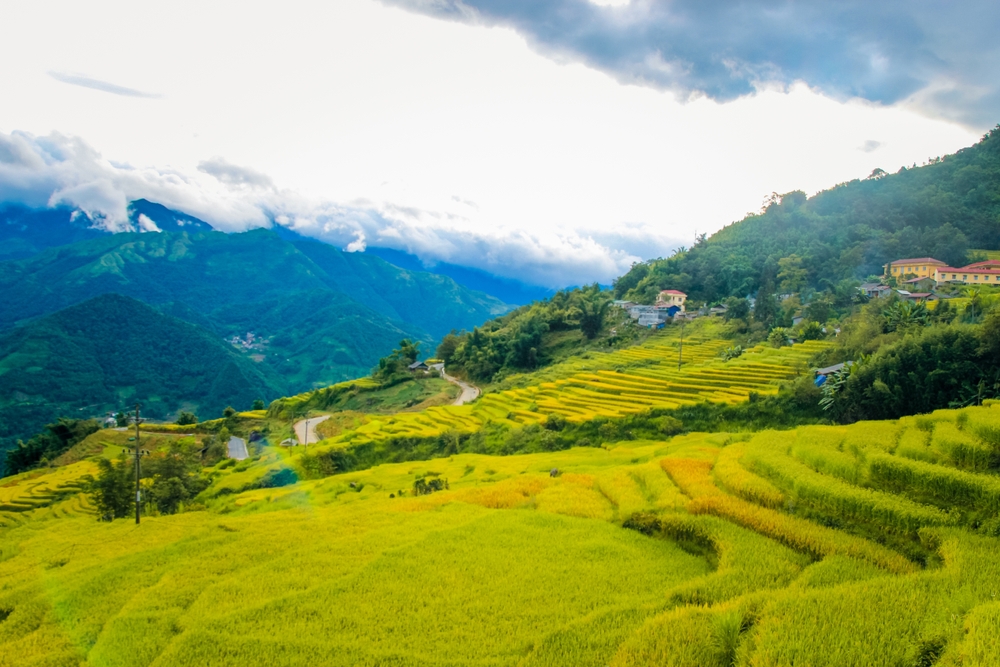
In the early morning in A Lù, the mist still lingers over the mountain ranges, and the terraced fields seem to be covered with a soft layer. As the sun rises, the curves become more pronounced, connecting along the gently sloping land from southeast to northwest, creating a scene that easily makes one want to stop for longer than planned.
Going to A Lù is not just about seeing the fields. It is also a visit to a border commune of Bát Xát district, where the roads, lifestyle, and landscape all carry the unique rhythm of the highland Lào Cai.
Highlights in A Lù
A Lù is located in the northwest of Bát Xát district, about 100 km from Bát Xát town. The terrain here is divided by high mountain ranges, so the roads are winding, and the views open up in segments. For those who enjoy scenic views from above, this type of road means that each bend can reveal a new layer of fields.
The most prominent feature remains the terraced fields. In Bát Xát, the terraced fields have become a memorable aspect of the region, and A Lù is the perfect place to appreciate that beauty in a still quite pristine space. If you go slowly, you will see that the fields are not just a scene, but also traces of the hard work of generations.
The cultural space in A Lù is also worth visiting. The commune is home to many ethnic minorities such as H’Mông, Dao, and Tày, so the rhythm of life here reflects local colors more than just pure sightseeing spots. For tourists, the interesting part sometimes lies in how the locals farm, work the fields, and converse in the village, rather than at a fixed check-in point.
Best Time to See Beautiful Fields
If your main goal is to admire the terraced fields, you should choose a time with stable weather and good lighting. Autumn is often the time to see the fields turning golden, while spring is suitable for viewing the hills in fresh green and clearer air. These are also the two periods often mentioned when traveling to Lào Cai in general.
During the rainy season, the mountain roads and routes to the highlands can be more slippery. At that time, while the scenery still has its own charm, moving around will require much more caution. If you are going to take photos, early morning or late afternoon usually provides soft lighting, suitable for the layered fields.
Where to go, where to stand to see the fields clearly
In A Lù, you should prioritize sections of the road with high and open views, especially in the A Lù slope area and the viewpoints along the road into the commune. This is a place where you don't need to find a rigid "attraction"; just standing in the right spot and looking down at the terraced fields hugging the mountainside will reveal the soul of the region.
If you want a deeper experience, take your time to stroll through the villages, stop to observe the fields coming into season, or chat with the locals when you have the chance. A Lù is not a place to rush. The beauty lies in giving yourself enough time to see how the roads, fields, villages, and daily activities connect with each other.
How to eat and rest appropriately
Public information about specific eateries in A Lù is limited, so the safest approach is to prepare for simple, light meals, then ask locals or stop at suitable points along the Bát Xát - A Lù route. For a trip to see the terraced fields, the food doesn't need to be elaborate; what's more important is to rest at the right moments, drink enough water, and not over-schedule your itinerary.
If you plan to visit multiple spots in Bát Xát, arrange your itinerary to match the beautiful morning roads, a short midday break, and take advantage of the evening to enjoy the scenery when the weather is mild. This way, the trip will be less tiring and you'll have more time to capture the moments when the fields change color with the light.
Small notes for the journey
A Lù is a mountainous commune, with some steep and rugged roads due to the high terrain. Therefore, drivers should go slowly, maintain distance, and avoid overly tight schedules if it rains. For first-time visitors to Bát Xát, it's best to start early to allow extra time to handle any unexpected situations on the road.
It's also important to note that A Lù is a border commune, so it's not a place to just breeze through for a few photos. A day trip can be tiring if you try to cover too many spots; going slowly and stopping at the right places will provide a much better experience. If you want to see the terraced fields in their most natural beauty, prioritize safety and flexibility in your schedule over trying to 'hunt' as many spots as possible.
For the people of Lào Cai, A Lù has a unique appeal: it's both near and far. Near because it is still part of the Bát Xát exploration route; far because every slope and every terraced field here retains a very distinct sense of untouched nature. And this is what makes A Lù a must-visit when you want to see the terraced fields at a slower, more genuine pace.